Greetings! I'm Aneesh Sreedharan, CEO of 2Hats Logic Solutions. At 2Hats Logic Solutions, we are dedicated to providing technical expertise and resolving your concerns in the world of technology. Our blog page serves as a resource where we share insights and experiences, offering valuable perspectives on your queries.

Quick Summary
Shopify offers five pricing tiers in 2026, from the entry-level Starter plan at $5/month to enterprise-grade Shopify Plus starting at $2,300/month. The three core plans, Basic ($39/month), Grow ($105/month), and Advanced ($399/month), all offer 25% discounts with annual billing.
New stores get 3 days free plus 3 months at $1/month. Real cost also includes payment processing, apps, and themes. Choose your plan based on sales volume, staff needs, and feature requirements, with most new stores starting on Basic and upgrading as they grow.
This guide will save you at least $1,200 this year.
Bold claim? Perhaps. But after helping dozens of businesses optimize their Shopify setups at 2HatsLogic, we have seen firsthand how even small adjustments to plan selection and payment processing can dramatically reduce expenses.
Shopify’s pricing isn’t designed to be transparent; it’s designed to maximize its revenue. And that’s fair. But as a store owner in 2026, you need to know exactly what you’re paying for and how to make those dollars work efficiently for your business.
Let’s cut through the marketing speak and get to the numbers that actually matter.
Is Shopify Free to Use?
Let’s address the elephant in the room first: Is Shopify free?
The short answer is no. Shopify doesn’t offer a free plan forever. However, it does provide a way to test the waters before you commit.
Shopify’s Free Trial
Shopify currently offers new users a 3-day free trial with no credit card required. This window is brief but gives users enough time to explore the platform’s features and interface.
What’s more enticing is what comes after: you can extend your trial by paying just $1/month for the next 3 months on Basic, Grow, or Advanced plans. That’s 93 days of full platform access for $3 total, a major upgrade from the previous “$1 for first month” offer.
Shopify Plus now offers an introductory trial: $399 for your first month before standard contract pricing kicks in.
This gives you ample time to:
- Set up your store completely
- Add products and collections
- Customize your theme
- Test the admin features
- Explore apps and integrations
- Process real customer orders (the checkout is fully enabled on the $1/month deal; unlike the bare 3-day trial)
The trial provides full access to whichever plan you select, allowing you to make an informed decision before committing to a regular subscription.
Credits promotion
Shopify currently layers an additional promotion on top of the $1 trial: new stores earn 1% back on sales as Shopify subscription credits. The cap depends on your plan:
Credit limits by plan
- Basic: up to $5,000 in credits
- Grow: up to $7,500 in credits
- Advanced: up to $10,000 in credits
This means sales can effectively cover your platform costs during growth. Terms and conditions apply; review the full offer details in your account.
1MBB Extended Trial (120 Days)
Through the Shopify and Operation HOPE 1MBB program (One Million Black Businesses), eligible merchants can access a 120-day extended trial along with specialized resources and coaching. Pricing post-trial is identical to the standard plans; the program adds time and support, not discounts.
Cancel Anytime Flexibility
One of Shopify’s most business-friendly policies is its flexible cancellation terms. If you choose a monthly plan, you can end your subscription anytime without penalties. For annual plans, you’ll need to wait until the end of your contract term to cancel.
This flexibility makes Shopify relatively low-risk to try, especially if you’re just starting out and unsure about your e-commerce journey.
Pro Tip: Use the 3-day free trial to plan your store, then claim the $1/month deal to actually build, launch, and start selling. You get 93 days at minimal cost, long enough to validate whether Shopify is the right platform for your business.
Ready to launch your Shopify store without overpaying?
Shopify Pricing Plans
Short answer: Shopify offers five plans in 2026, ranging from $5/month (Starter) to $2,300+/month (Plus). The three core plans, Basic, Grow, and Advanced, save 25% with annual billing.
Let’s break down how much Shopify costs on a monthly basis and what each plan offers.
At-a-Glance Comparison
| Plan | Monthly | Annual (Effective Monthly) | Best For |
| Starter | $5 | $5 | Social media sellers |
| Basic | $39 | $29 | New stores, under $5K monthly |
| Grow | $105 | $79 | Established, $5K–$25K monthly |
| Advanced | $399 | $299 | High volume, $25K+ monthly |
| Plus | from $2,300 (3-year term) | Custom contract | Enterprise |
| POS Pro | $89 per location | — | In-person sellers (add-on) |
Shopify Starter
The Shopify Starter plan is the most affordable option, designed for newcomers to e-commerce. At just $5 per month, it’s ideal for selling products via social media, SMS, email, and other platforms.
However, there’s a significant limitation: this plan doesn’t include a standalone online store. Instead, it provides tools to sell through existing channels and social media.
Best for: Side hustlers, content creators with existing audiences, or businesses testing the waters before investing in a full online store.
Shopify Basic
The Basic Shopify package costs $39 per month, or you can get a 1-year plan at the equivalent of $29 per month.
This plan includes:
- Full online store with blog functionality
- Unlimited products
- Up to 10 inventory locations
- Basic reports
- Abandoned cart recovery
- Shipping discounts up to 77%
- Agentic commerce and customizable checkout
- 24/7 chat support
Look out for: Shopify offers a 25% discount for yearly subscriptions if you choose the Basic, Grow, or Advanced plans. This can lead to significant savings for businesses committed to the platform.
Shopify Grow Plan
The middle tier, now called the Grow plan, costs $105 when billed monthly or $79 monthly with annual billing.
This plan includes everything in Basic, plus:
- 5 staff accounts
- Professional reporting
- Up to 10 inventory locations
- Lower transaction fees
- Shipping discounts up to 87% plus shipping insurance
Best for: Growing businesses that need better analytics and more staff accounts to manage operations.
Advanced Shopify
With the best Shopify features, this top-tier Shopify subscription is priced at $399 per month. When paid annually, it comes down to $299 per month.
This plan includes everything in the Grow plan, plus:
- 15 staff accounts
- Advanced report builder
- Third-party calculated shipping rates
- Duty and import tax calculations
- The lowest transaction fees
- Shipping discounts up to 87% plus shipping insurance
- Local storefronts by market
Best for: High-volume businesses that need sophisticated analytics or international sellers who need advanced shipping and tax features.
Shopify Plus (Enterprise pricing)
Shopify Plus starts at $2,300/month on a 3-year contract term. 1-year terms are also available at a higher monthly rate. Shopify offers the discounted rate plus lower online variable platform fees as an incentive to commit to the 3-year contract.
These are introductory list rates for standard setups. Actual monthly costs can climb significantly for high-volume merchants; stores doing $1M+ in revenue typically pay $5,000-$8,000/month after factoring in variable platform fees, and $10M+ merchants can see $15,000-$25,000/month.
Shopify Plus offers enterprise-level features, including:
- Unlimited transactions with 99.99% uptime
- Dedicated support team
- API access for custom integrations
- Advanced customization options
- Checkout customization
- Multiple expansion stores
- Up to 200 inventory locations
- Up to 200 POS Pro locations included
- Unlimited staff accounts
- B2B/wholesale selling built in
Best for: Large enterprises and high-growth businesses that need maximum customization and support.
Shopify POS Pro ($89/month per location)
For merchants selling both online and in-person, Shopify POS Pro is an add-on subscription priced at $89/month per retail location. POS Lite is included with all standard plans, but POS Pro unlocks unlimited POS staff, buy-online-pickup-in-store, exchanges, staff roles and permissions, and in-store analytics.
Worth budgeting for separately if you have physical retail, it can quickly become the second-largest line item after your base plan.
Monthly vs Annual Billing
Switching from monthly to annual billing saves exactly 25% on Basic, Grow, and Advanced plans. Here’s what that looks like in dollars:
- Basic: $39 → $29/month: saves $120/year
- Grow: $105 → $79/month: saves $312/year
- Advanced: $399 → $299/month: saves $1,200/year
The trade-off: annual contracts are paid upfront, and cancelling mid-term doesn’t give you a prorated refund. Start monthly during your build phase, then switch once you’re committed.
Not sure which Shopify plan fits your business?
Shopify’s 2026 AI & Agentic Commerce Features
Shopify rolled out a major AI push in 2026, and several features now ship by default with the Basic plan, which affects your “build vs buy” calculations for apps.
What’s Included by Default
The Basic plan in 2026 now includes:
- Agentic commerce: AI agents (ChatGPT, Perplexity, and similar) can interact with your store on behalf of customers as AI-driven shopping becomes a real channel
- Customizable checkout: previously a Plus-only feature, now available on Basic with some limitations
- Shopify Magic: AI-generated product descriptions, image editing, and email copy
- Sidekick: Shopify’s in-admin AI assistant for analytics queries and operational tasks
Do These Features Reduce Your Shopify App Spend?
Somewhat. Built-in AI product description generation can replace tools like Copysmith or Jasper for basic copy. Sidekick’s analytics queries can reduce dependence on premium reporting apps. But agentic commerce and AI checkout features are still maturing, most established stores will keep their existing app stack and use Shopify’s AI features as supplements rather than replacements.
Realistic 2026 estimate: built-in AI may shave $20-$50/month off typical app spend, but won’t fundamentally change the $50–$200/month app range for most stores.
How Much Does Shopify Take Per Sale?
This is where things get interesting, as how much Shopify takes per sale depends on two key factors:
- Your subscription plan
- Whether you use Shopify Payments or a third-party payment processor
Shopify Payments Fees
When using Shopify’s built-in payment processor (Shopify Payments), you’ll pay these credit card rates for online transactions:
| Plan | Online Credit Card Rates | In-Person Rates |
| Basic | 2.9% + 30¢ | 2.7% + 0¢ |
| Grow | 2.6% + 30¢ | 2.5% + 0¢ |
| Advanced | 2.4% + 30¢ | 2.4% + 0¢ |
| Plus | Negotiable | Negotiable |
As you can see, the higher your plan, the lower your payment processing fees become.
Third-Party Payment Gateway Fees
If you choose not to use Shopify Payments (or if it’s unavailable in your country), third-party transaction fees apply:
2% for the Basic plan, 1% for the Grow plan, and 0.6% for the Advanced plan.
This is in addition to whatever fees your chosen payment processor charges.
Pro Tip: Use Shopify Payments if available in your region. The absence of additional transaction fees alone can save you thousands of dollars annually, especially as your sales volume grows.
Cost of a Shopify Store
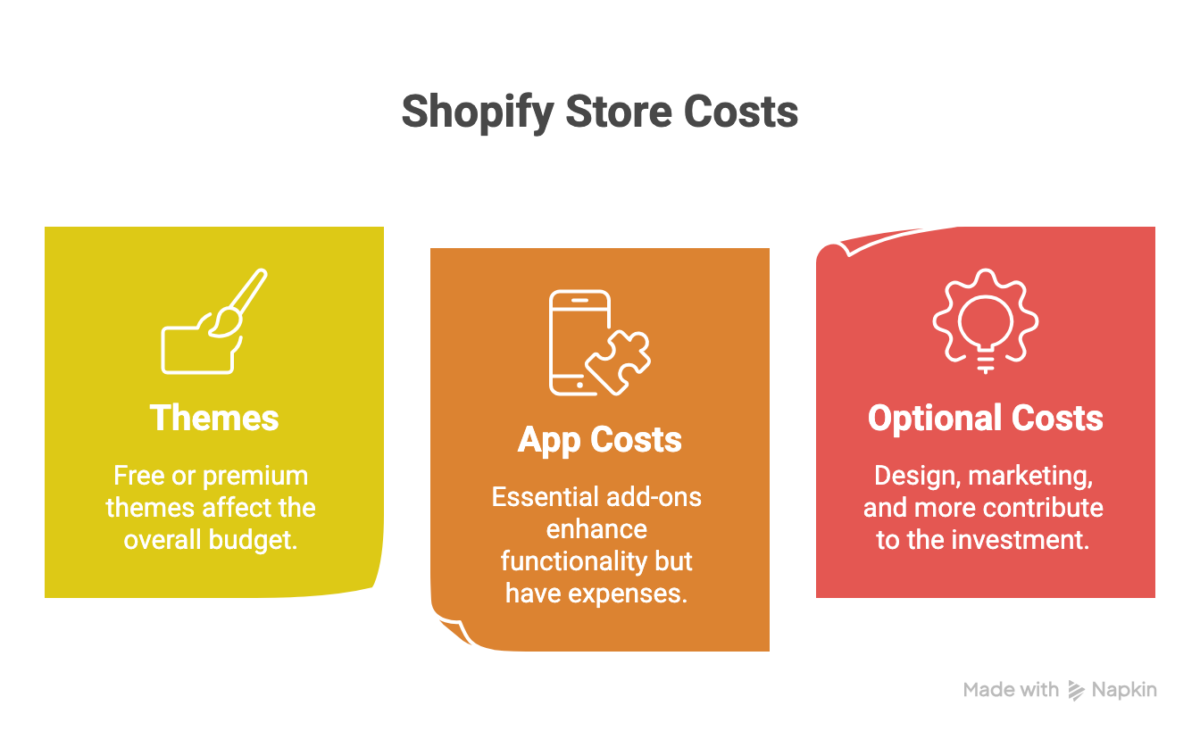
Now, how much is a Shopify store really going to cost you? Beyond the subscription and transaction fees, there are several other potential expenses to consider.
Apps and Monthly App Spend
The Shopify App Store is packed with extensions that can enhance your store’s functionality. The store now hosts over 8,000 apps as of 2026, and while many basic apps are free, premium ones typically cost between $5 and $200 per month.
Common app categories include:
- Email marketing tools
- SEO optimization
- Inventory management
- Customer reviews
- Upselling and cross-selling
- Abandoned cart recovery (included in all plans except Starter)
- Loyalty and subscription programs
- AI-powered personalization (newer category)
For a typical store, budgeting $50-$200/month for essential apps is reasonable.
Themes: Free vs Premium
Shopify offers several free themes that are perfectly adequate for many businesses. As of 2026, there are 24 free themes and over 1,000 paid options. Premium themes with advanced features and specialized designs typically range from $140 to $350 as a one-time purchase.
A well-designed theme can dramatically improve conversion rates, making this investment potentially worthwhile for serious e-commerce businesses.
Domain, Email Hosting & SSL
- Domain: $14–$20/year (a free myshopify.com subdomain is included, but custom domains are non-negotiable for serious brands)
- Professional email hosting: $5–$10/user/month via Google Workspace or Microsoft 365
- SSL: included free on all Shopify plans
International Selling Fees
When accepting payments in a currency different from your payout currency, Shopify charges a currency conversion fee of 2% for stores in most countries.
Additionally, customers making international purchases may face fees from their own banks or credit card issuers, potentially affecting conversion rates.
POS Hardware (For In-Person Sellers)
If selling in person, essential equipment like a card reader ($49–$299), barcode scanner ($229+), receipt printer ($149+), and cash drawer ($139+) can quickly add up, with total costs ranging from $500 to $1,000+ per store location. Plus, the POS Pro subscription is at $89/month per location if you need advanced features.
Tax, Accounting & Compliance Apps
Often overlooked but real costs for established businesses:
- Avalara, TaxJar, or Quaderno: $20–$100/month for automated tax calculations
- Sufio or similar for VAT-compliant invoicing (DACH/EU): $19–$59/month
- Accounting integrations (Xero, QuickBooks, DATEV): $5–$30/month
When to Upgrade Your Plan
Knowing when to upgrade is crucial for optimizing your Shopify costs. Consider moving to a higher plan when:
- Transaction Fees: The savings on payment processing fees exceed the difference in monthly subscription costs.
- Staff Limitations: You need more staff accounts than your current plan allows.
- Reporting Needs: You require the advanced analytics offered in higher tiers.
- International Selling: You need the advanced duty and tax features in the Advanced plan.
Let us calculate your exact upgrade break-even point.
The simple formula:
Break-even monthly revenue = (New plan cost − Current plan cost) ÷ (Current rate − New rate)
Shopify Pricing for Beginners vs Enterprises
Choosing the right plan depends largely on where your business stands in its growth journey.
Best Plan for First-Time Sellers
For most beginners, the Basic Shopify plan offers the best balance of features and cost. At $39/month (or $29/month with annual billing), it provides all the essential tools to launch and grow an online store.
Start with Basic if:
- You’re launching your first e-commerce store
- Your monthly sales are under $5,000
- You don’t need advanced reporting
- You have a small team (1-2 people)
The additional transaction fees on higher plans rarely justify the upgrade for businesses at this stage.
When to Use Shopify Plus
Shopify Plus is a great option for very successful and high-growth businesses that require the most advanced online store features.
Consider Shopify Plus if you:
- Process millions in annual sales
- Need enterprise-level support
- Require advanced customization
- Sell internationally across multiple storefronts
- Need specialized checkout experiences
- Have complex B2B requirements
When to Upgrade Your Plan
Knowing when to upgrade is crucial for optimizing your Shopify costs. Consider moving to a higher plan when:
- Transaction Fees: The savings on payment processing fees exceed the difference in monthly subscription costs.
- Staff Limitations: You need more staff accounts than your current plan allows.
- Reporting Needs: You require the advanced analytics offered in higher tiers.
- International Selling: You need the advanced duty and tax features in the Advanced plan.
Pro Tip: Do the math on transaction fees before upgrading. For many businesses, the Advanced plan becomes more economical than the Grow plan once monthly sales exceed $27,000, purely based on payment processing savings.
Shopify Pricing Compared to Alternatives
To fully understand if Shopify offers good value, let’s compare it to some popular alternatives.
| Platform | Starting Price | Transaction Fees | Sales Limits | App Ecosystem |
| Shopify | $39/month | 0% w/ Shopify Payments, 0.6–2% otherwise | None | Extensive (8,000+) |
| WooCommerce | Free + hosting | Depends on the gateway | None | Extensive |
| Wix | $27/month | None | None | Limited |
| BigCommerce | $39.95/month | None on any plan | Yes (revenue caps) | Moderate |
| Shopware | Open source / from €600/month enterprise | Depends on the gateway | None | Strong in DACH |
Shopify vs WooCommerce
WooCommerce
- Initial Cost: Free plugin (open-source)
- Hosting: $5-$300/month (not included)
- Themes: $0-$200 (one-time)
- Plugins: $0-$300/month
- Transaction Fees: Depending on the payment processor
Total WooCommerce Cost: While the platform itself is free, most stores end up paying $50-$250/month for hosting, essential plugins, and maintenance.
Key Difference: WooCommerce has lower upfront costs but requires more technical knowledge and often ends up with similar total costs when accounting for hosting, security, and essential extensions.
Shopify vs Wix
Wix eCommerce
- Business Basic: $27/month
- Business Unlimited: $32/month
- Business VIP: $59/month
- Transaction Fees: None with Wix plans
- Apps: $0-$50/month typical
Key Difference: Wix is less expensive for basic stores but lacks Shopify’s specialized e-commerce features, scalability, and app ecosystem as your business grows.
Shopify vs BigCommerce
BigCommerce
- Standard: $39.95/month
- Plus: $105.95/month
- Pro: $379.95/month
- Transaction Fees: None on any plan
- Sales Limits: Each plan has maximum annual sales limits
Key Difference: BigCommerce has no transaction fees regardless of payment processor, but enforces sales limits that force you to upgrade plans as your business grows. Shopify has no sales limits but charges transaction fees for external payment gateways.
How to Avoid Overpaying on Shopify
Using Shopify Payments, where available, eliminates the 0.6%-2% third-party gateway surcharge.
Switch to annual billing once committed, guaranteed 25% saving on Basic, Grow, and Advanced.
Audit your apps quarterly; most stores have 2-3 apps they no longer use but still pay for.
Calculate your break-even point before upgrading. A pure transaction-fee upgrade from Basic to Grow only pays off above ~$25K/month in revenue, and Grow to Advanced above ~$110K/month. Most upgrades are justified by features (staff seats, reporting) rather than fee savings.
Negotiate Plus contracts at scale. If you’re approaching $1M+ in annual revenue, the Plus sales team has more flexibility than the public pricing suggests. Committing to a 3-year term unlocks both a monthly discount and lower variable platform fees.
Reduce refund and chargeback exposure, clearer product photos, better size guides, and proactive customer service all reduce processing fee waste.
Final Thoughts: Picking the Right Shopify Plan
After helping dozens of businesses optimize their Shopify setups at 2HatsLogic, we have found that the right plan isn’t always the most obvious choice. Here’s my summary of who each plan works best for:
- Starter ($5/month): Social media sellers with an existing audience
- Basic ($39/month): New online stores with under $5,000 in monthly sales
- Grow ($105/month): Established stores with $5,000-$25,000 in monthly sales
- Advanced ($399/month): High-volume or international sellers with $25,000+ monthly
- Plus ($2,300+/month): Enterprise businesses with unique requirements
Tips to Avoid Overpaying
Start Small, Scale Up: Begin with the Basic plan and upgrade only when you’ve outgrown its capabilities.
Calculate Your Break-Even Point: Do the math on transaction fees to determine when upgrading makes financial sense.
Pay Annually: Save 25% on Basic, Grow, and Advanced plans by paying yearly instead of monthly.
Audit Your Apps Quarterly: Remove unused or underperforming apps to reduce subscription fatigue.
Use Shopify Payments When Possible: Avoid the additional transaction fees charged for third-party payment processors.
Remember that the cheapest plan isn’t always the most economical in the long run. Consider the total cost of ownership, including transaction fees, time savings, and the value of built-in features versus paid apps.
Conclusion
Choosing the right Shopify plan is more art than science; it requires balancing your current needs, growth trajectory, and budget constraints. With the information in this guide, you’re now equipped to make a decision that aligns with your business goals.
Need help setting up or optimizing your Shopify store? At 2HatsLogic, we specialize in helping businesses maximize their e-commerce potential with expert Shopify development and optimization.
From choosing the right plan to implementing headless commerce solutions that drive conversion, our team has the expertise to take your online store to the next level.
Ready to stop overpaying and start scaling?
FAQ
How much does Shopify really cost in 2026?
Shopify costs between $5 and $2,300+ per month for plan fees alone in 2026. Most established stores spend 4–6% of revenue on Shopify total (plan + payment processing + apps).
Can I run a store on Starter forever?
You can use the Starter plan indefinitely, but remember that it doesn't include a standalone online store. If you only sell through social media and don't need your own website, it can be sufficient. However, most growing businesses will eventually need the features of a Basic plan or higher.
Can I downgrade my Shopify pricing plan?
Yes, Shopify allows you to change plans at any time. On most Shopify plans, you can upgrade or downgrade your plan at any time. If you find you're paying for features you don't use, downgrading is simple.
Is Shopify Plus too expensive for medium-sized brands?
For many medium-sized businesses, Shopify Plus is indeed overkill. The Advanced plan offers most of the features needed by businesses doing up to several million in annual sales. Shopify Plus becomes worth considering when you need enterprise-grade support, elaborate customizations, or managing multiple storefronts.
Table of contents
- Is Shopify Free to Use?
- Shopify Pricing Plans
- Shopify's 2026 AI & Agentic Commerce Features
- How Much Does Shopify Take Per Sale?
- Cost of a Shopify Store
- When to Upgrade Your Plan
- Shopify Pricing for Beginners vs Enterprises
- Shopify Pricing Compared to Alternatives
- How to Avoid Overpaying on Shopify
- Picking the Right Shopify Plan
- Conclusion

Related Articles