
Greetings! I'm Aneesh Sreedharan, CEO of 2Hats Logic Solutions. At 2Hats Logic Solutions, we are dedicated to providing technical expertise and resolving your concerns in the world of technology. Our blog page serves as a resource where we share insights and experiences, offering valuable perspectives on your queries.

Choosing the right e-commerce platform is no longer just about launching an online store. In Germany, online product spending reached 83.1 billion euros last year, while combined online product and digital service sales climbed to 97.5 billion euros. This shows how important it is for businesses to use platforms that can scale with demand.
Today, businesses need a platform that can handle growth, support multiple sales channels, and integrate with ERP and PIM systems. It aims to deliver a smooth customer experience across devices. In Germany, where e-commerce continues to grow, and online shopping remains a major part of consumer behavior, businesses increasingly need platforms that are flexible, scalable, and built for long-term digital commerce success.
This is where Shopware 6 stands out. Built in Germany and designed for modern commerce needs, it provides businesses with the flexibility, customization, and integration capabilities to support both B2C and B2B growth. Whether a company is expanding into new markets, managing complex product catalogs, or seeking a more adaptable commerce solution, Shopware 6 provides a strong foundation for scaling online operations.
See how Shopware 6 helps businesses scale beyond traditional online stores.
What is Shopware 6?
Shopware 6 is a modern, open-source e-commerce platform designed to help businesses build flexible and scalable online stores. It provides a powerful foundation for both B2C and B2B commerce. Your business can manage products, customers, and sales channels from a single system. Originally developed in Germany, Shopware has grown into a globally recognized e-commerce platform used by businesses worldwide.
Shopware 6 uses a robust technology stack based on Symfony and follows an API-first approach. This makes it easier to integrate with third-party systems and customize accordingly.
It is available in multiple editions designed for different business needs. In addition to the free Shopware Community Edition (CE), Shopware also offers commercial plans such as Rise, Evolve, and Beyond. This includes advanced features, cloud services, and enterprise-level support.
This flexible edition structure allows businesses to choose a solution based on their requirements. It can include scalability, customization needs, and operational complexity.
Why Shopware 6 Matters for Modern E-commerce
The e-commerce landscape has changed rapidly in recent years. Businesses are no longer just building online stores; they are creating scalable digital commerce experiences that can support growing customer expectations and complex operations.
This is where the Shopware online shop stands out. It is designed to support growing businesses with strong customization options, advanced integrations, and a modern architecture.
Shopware 6 has also gained strong recognition in the European eCommerce market. According to Emerce 100, Shopware is recognized as the leading e-commerce platform in Europe. This reflects its growing adoption and market credibility.
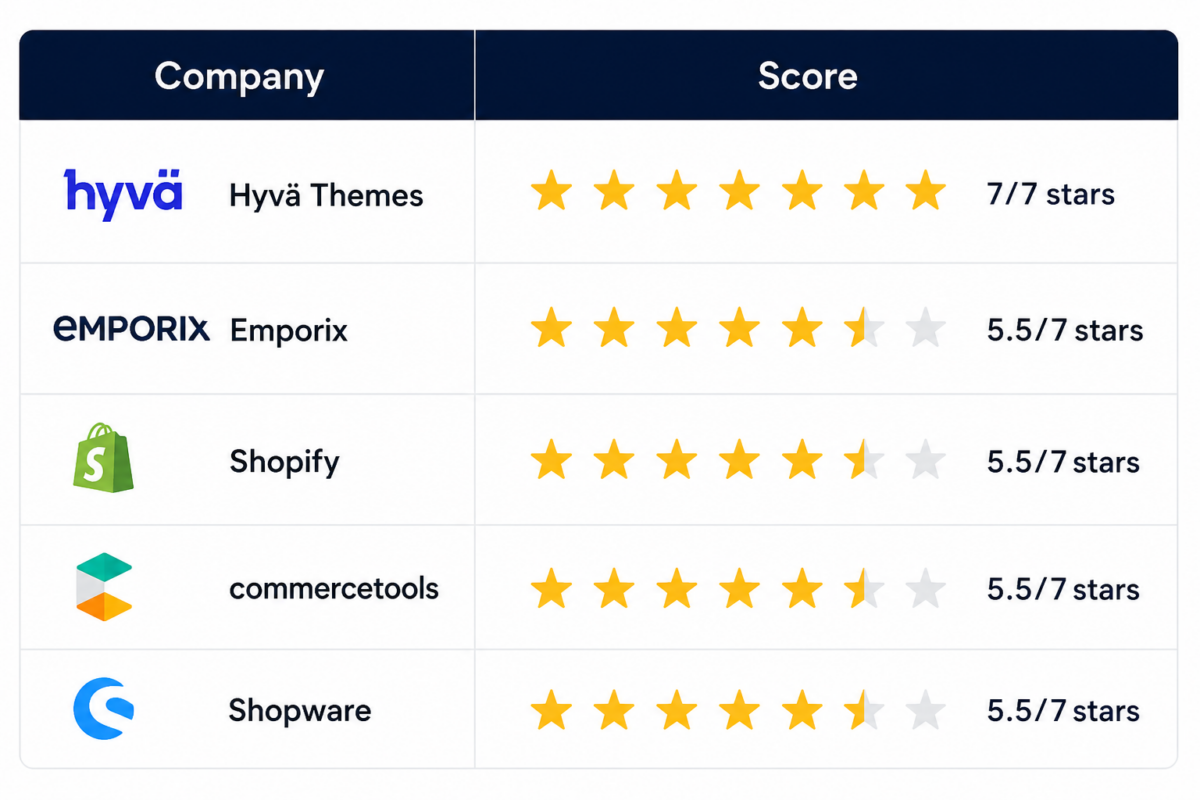
Top 5 E-Commerce Platform Rankings – Emerce100 2026. Source: Emerce100 2026
Who is Shopware 6 for?
The Shopware e-commerce platform is suitable for businesses of all sizes. But it is particularly beneficial for companies that need flexibility and scalability in their e-commerce operations.
It is commonly used by:
- Growing online stores are planning to scale their product catalog
- B2B and B2C businesses managing complex sales processes
- Brands expanding into multi-store or international markets
- Companies that require custom integrations with ERP, PIM, or other systems
Its modular structure allows businesses to start small and expand as their needs evolve.
How Shopware 6 is Different from Traditional E-commerce Platforms
Unlike traditional e-commerce platforms that often rely on rigid structures, Shopware 6 offers a more flexible and customizable approach.
Key differences include the following:
- API-first architecture that enables seamless integrations.
- Headless commerce capabilities for custom frontend experiences.
- Advanced customization through plugins and extensions.
- Scalable infrastructure designed to support growth and large product catalogs.
Key Features of Shopware 6
Shopware 6 offers a wide range of features designed to support modern e-commerce businesses. From flexible architecture to advanced customization and built-in optimization tools. It provides the tools needed to build and scale a powerful online store.
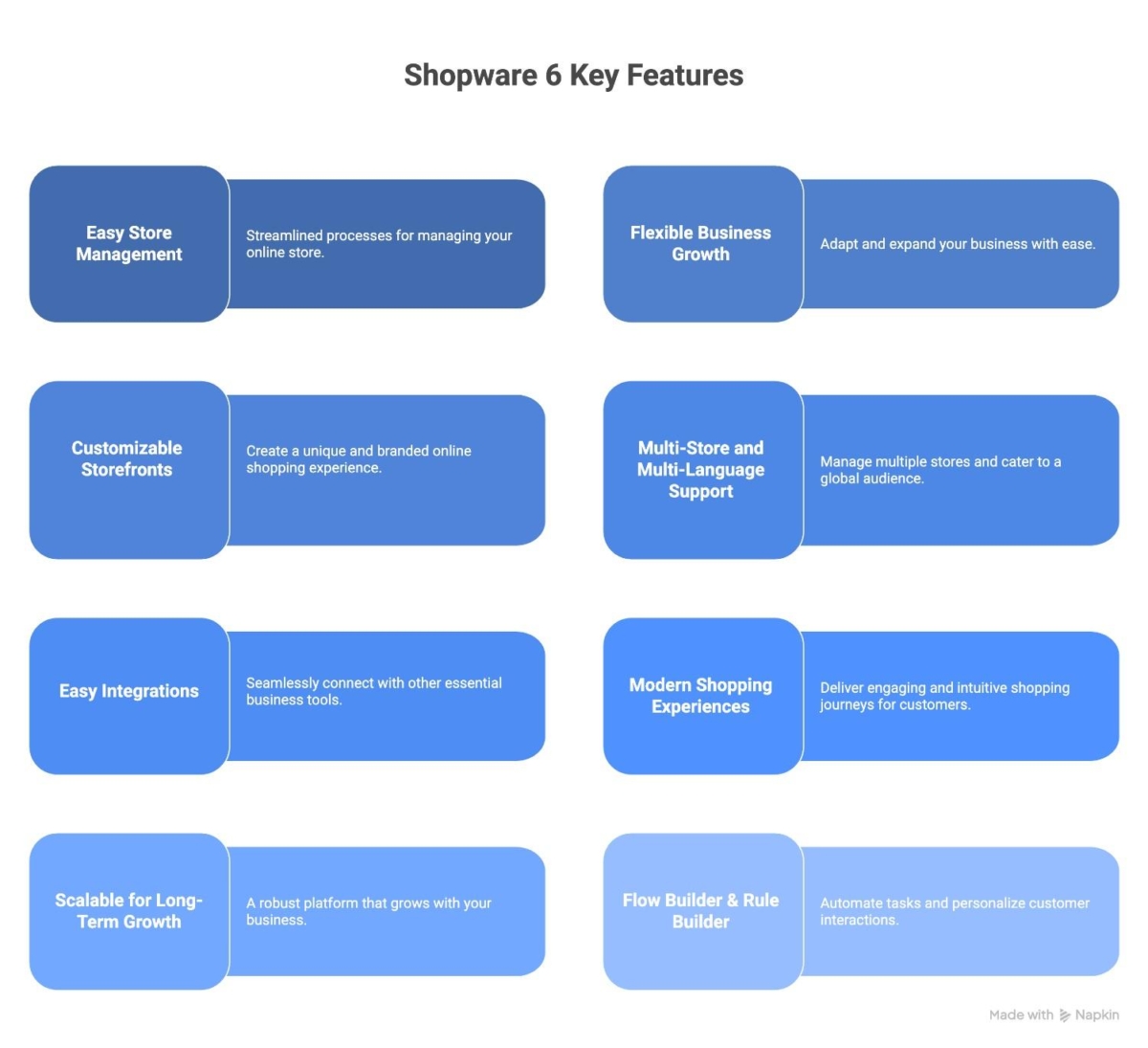
Easy Store Management
Shopware 6 backend is clear and organized, which makes your day-to-day store management easier. From product updates to order handling, teams can manage key tasks more efficiently without needing a highly technical setup.
Flexible Business Growth
One of the biggest strengths of Shopware 6 is its flexibility for growing businesses. It supports evolving business needs, larger catalogs, and new sales channels. This makes it a strong option for companies seeking an e-commerce platform that adapts as they expand. For businesses planning long-term growth, Shopware 6 offers a future-ready foundation.
Customizable Storefronts
Shopware 6 gives businesses the freedom to create storefronts that match their brand and customer expectations. With plugins, extensions, and design flexibility, companies can shape the look and feel of their online store without being locked into a rigid structure. This level of customization is one reason many businesses choose Shopware 6 for modern e-commerce development.
Multi-Store and Multi-Language Support
For businesses selling across different regions, Shopware 6 offers strong multi-store and multi-language capabilities. This makes it easier to manage separate storefronts, localize content, and create a better shopping experience for different audiences. It is especially useful for brands that want to scale internationally on a single platform.
Easy Integrations
Shopware 6 is built to connect with the tools businesses already use, such as ERP, PIM, CRM, payment systems, and shipping services. These integration options help improve workflows, reduce manual work, and keep business data more organized. For growing companies, Shopware 6 is a smart choice for connected e-commerce operations.
Modern Shopping Experiences
Shopware 6 helps businesses create shopping experiences that feel engaging and easy to navigate. Its content and commerce features let teams build product pages, landing pages, and category layouts that support both storytelling and sales. This is useful for brands that want more than a basic online store and want to deliver a more polished e-commerce experience.
Scalable for Long-Term Growth
Shopware 6 is designed to support businesses as they grow over time. Whether a company is adding more products, handling more traffic, or expanding into new markets, the platform can scale with its needs. That makes it a strong option for businesses looking for an e-commerce platform that can support both current operations and future growth.
Flow Builder & Rule Builder
Shopware 6 includes built-in automation tools such as Flow Builder and Rule Builder. Helping businesses to automate repetitive tasks and create flexible workflows without heavy custom development.
Rule Builder allows businesses to define conditions based on customer behavior, cart values, shipping methods, products, or sales channels. Flow Builder then uses these rules to automate actions such as sending emails, assigning tags, updating order statuses, or triggering operational workflows.
These features help businesses improve efficiency, personalize customer experiences, and manage complex eCommerce operations more effectively.
Shopware 6 Technology & Architecture
Shopware 6 uses a modern technology stack that supports flexibility, scalability, and integration capabilities. The platform helps businesses build more than a standard online store by adapting to evolving commerce operations and growth requirements.
| TECHNOLOGY | ROLE IN SHOPWARE |
| Symfony | Modern PHP framework for better performance and flexibility. |
| Twig | Template engine for creating responsive designs. |
| Bootstrap | Mobile-friendly with responsive user interfaces. |
| Vue.js | For effective and interactive frontend experiences. |
| SCSS | Keep your store’s design consistent and scalable. |
Symfony & PHP Foundation
Shopware 6 uses Symfony and PHP to provide a stable and scalable backend foundation for modern e-commerce development. Symfony’s modular framework allows developers to create custom business logic, integrations, and extensions.
This strong backend architecture also supports enterprise-level performance, security, and scalability requirements.
Backend & Admin Experience
The Shopware 6 backend provides merchants with a clear and practical administration experience. Users can manage products, orders, customers, content, extensions, and store settings more efficiently.
The administration panel is built using Vue.js. This creates a modern and responsive backend experience that also supports easier customization and plugin development.
API-First & Integration Capabilities
A major advantage of Shopware 6 is its API-first architecture. With both Store API and Admin API support, businesses can integrate the platform with ERP, PIM, CRM, payment gateways, mobile applications, and third-party tools more efficiently.
This approach also supports headless commerce, where the frontend and backend operate independently. This allows businesses to build flexible and customized commerce experiences across multiple channels.
Modular Architecture
Shopware 6 follows a modular architecture, giving businesses the flexibility to extend and customize the platform as their requirements evolve. Instead of relying on a rigid structure, merchants can add features, plugins, and integrations that support long-term growth and operational flexibility.
Scalability Foundations
Shopware 6 supports scalable infrastructure technologies. They include MySQL, Redis, Elasticsearch, Varnish, and CDN integrations to improve performance, caching, and search capabilities.
Combined with cloud and scalable hosting environments, this technology stack helps businesses efficiently manage large product catalogs, growing traffic, and multi-store operations.
Shopware Use Cases
Shopware 6 is flexible enough to support different business models, from direct-to-consumer brands to complex B2B operations and international commerce setups. Its modular structure, multi-store capabilities, and API-first architecture make it suitable for businesses that need a platform adapted to specific operational needs. Shopware also supports important storefront and checkout-related needs, including features that matter for B2C businesses.
B2C e-commerce
Shopware is a strong fit for B2C businesses that want to create engaging online shopping experiences. It supports modern storefront design, product storytelling, and flexible content layouts that help consumer brands present their products more effectively.
For example, our Bike2Care project shows how Shopware can support a modern B2C brand experience for a German e-bike online store.
B2B e-commerce
Shopware also works well for B2B businesses that need more than a standard online catalog. It can support tailored pricing, role-based purchasing, and more complex sales workflows, which are important for wholesale and business-focused operations.
This makes it a practical choice for companies that need to manage structured buying processes while still offering a smooth digital experience.
Multi-store & International Businesses
For businesses operating across multiple regions, Shopware provides strong support for multi-store and multi-language commerce. Brands can manage multiple storefronts, sales channels, and localized customer experiences from a single platform. This is especially useful for companies expanding into international markets or running separate storefronts for different audiences.
Industry Use Cases
Shopware is used across several industries, including fashion, retail, electronics, manufacturing, and food and beverage. Its flexibility makes it easier to adapt the platform to the needs of different product types and customer journeys. Whether a business needs a visually rich storefront or a structured catalog experience, Shopware can be shaped to fit the industry.
Migration Use Case
Shopware is also a strong option for businesses planning to upgrade or migrate from another platform. Our Shopware 5 to 6 migration case study shows how the platform supports businesses moving to a more modern and scalable architecture.
This makes Shopware a relevant choice not only for new stores but also for companies that want to future-proof their existing e-commerce setup.
Shopware References: Real-World Project Examples
Looking for Shopware references before starting your next e-commerce project? Real-world examples can help you understand how businesses use Shopware for store migrations, custom development, third-party integrations, performance improvements, and ongoing support. Reviewing successful Shopware projects can also provide ideas and best practices for your own online store.
Browse our Shopware case studies to discover how businesses have implemented Shopware to solve challenges, streamline operations, and create better shopping experiences for their customers.
Shopware Performance & Scalability
Shopware is a strong fit for businesses that want a platform capable of growing with them. For us, the important part is not just whether the platform is fast on paper, but whether it can support real store growth, larger catalogs, and changing business needs without becoming difficult to manage.
Can Shopware handle large product catalogs?
Yes, Shopware 6 will handle large product catalogs when businesses configure the store properly and use the right infrastructure. We have seen that the platform works well for businesses that need to manage many products, category layers, and growing operational complexity while still keeping the store usable for customers.
For projects with a heavy product load, the real advantage is flexibility. Shopware gives merchants a structure that can handle growth without forcing them into a rigid setup. This makes it easier to scale product management over time.
Performance Optimization Capabilities
In our experience, Shopware performance is not only about the platform itself but also about how the store is built and maintained. Image size, database setup, caching strategy, and frontend efficiency all affect how fast a store feels to customers.
That is why performance tuning matters so much. A well-optimized Shopware store can deliver a smoother experience, reduce load times, and stay more stable as traffic increases.
Caching, CDN & Search Optimization
Caching plays a major role in keeping a Shopware store fast. With tools like HTTP cache, Redis, and reverse proxy support, the platform can reduce unnecessary processing and respond more efficiently to repeated requests.
A CDN can also help improve delivery speed for users in different locations, while search tools like Elasticsearch or OpenSearch make large catalogs easier to browse and search. Together, these components help Shopware support stores that need both speed and scale.
Regular Updates & Future Scalability
Shopware 6 continues to evolve with regular feature updates, performance improvements, security enhancements, and modern commerce capabilities. Businesses can upgrade to newer Shopware versions to access improved functionality, better integrations, and long-term platform support.
This ongoing development approach helps businesses keep their e-commerce operations aligned with changing customer expectations and digital commerce trends.
Shopware SEO & Optimization
Shopware gives businesses a solid SEO foundation, but results still depend on how well the store is configured and maintained. The advantage of Shopware SEO is that it combines native SEO controls with enough flexibility to support long-term optimization as the store grows. For a more detailed look at improving rankings, metadata, URLs, page speed, and technical optimization, explore our complete Shopware SEO guide.
Built-in SEO Features
Shopware includes built-in SEO features that help stores get started with search visibility. These include SEO-friendly URLs, editable metadata, and sitemap support, which give merchants control over how their pages appear in search.
Technical SEO (URLs, sitemap, metadata)
A big part of Shopware technical SEO is keeping the store structure clean and crawlable. That means using SEO URLs properly, managing metadata consistently, and making sure sitemap and canonical settings are handled correctly.
On-page Optimization Strategies
Shopware on-page SEO works best when product pages and category pages are built for both search engines and users. Strong meta titles and descriptions, clear headings, internal linking, and image alt text all help improve visibility and make the content more useful.
Shopware ERP, PIM & Integrations
Shopware ERP, PIM, and third-party integrations are important for businesses that want their eCommerce store to connect smoothly with internal systems and external tools. As stores grow, it becomes more important to connect product data, payments, shipping, CRM, and marketing tools in one setup.
ERP Integration
Shopware ERP integration helps businesses connect their store with systems used for inventory, order management, accounting, and operations. This makes it easier to keep business data aligned across teams. Shopware can work with ERP systems such as Business Central, SAP, Xentral, Dynamics 365, Odoo, and NetSuite, depending on the business setup.
PIM Integration
Shopware PIM integration is useful for businesses that manage large or complex product catalogs. It helps teams improve product information management, keep product data consistent, and sync product content more efficiently across channels. This is especially helpful for businesses using tools like Akeneo or Pimcore.
Third-party Integrations
Shopware third-party integrations help extend the platform beyond the store itself. Businesses can connect payment, shipping, CRM, and marketing tools such as HubSpot, Klaviyo, DHL, Stripe, and PayPal to create a more complete commerce workflow.
Shopware Plugins, Themes & Ecosystem
Shopware plugins and the wider Shopware ecosystem make it easier for businesses to extend the platform based on their needs. Whether a store needs extra functionality, a new design direction, or stronger support, the ecosystem gives teams room to customize and grow.
Plugin Marketplace
The Shopware plugin marketplace, also known as the Shopware Store, gives users access to a wide range of extensions that add new features to the platform. Businesses can find plugins for payments, SEO, marketing, and operations, which makes it easier to expand store functionality without building everything from scratch.
Themes & Customization
Shopware themes and theme customization give businesses control over the look and feel of their storefront. With support for custom Shopware themes and storefront design changes, merchants can adjust the visual experience to better match their brand and customer expectations.
Shopware Support & Community
Shopware also has a strong community and support ecosystem, which includes documentation, partners, agencies, and developer resources. This makes it easier for businesses to get help, find implementation support, and work with experienced Shopware professionals when needed.
Shopware Accessibility
Shopware is built with accessibility in mind and continues to improve storefront usability for a wider range of users. According to Shopware’s documentation, accessibility applies to the core storefront as well as custom themes and extensions. Businesses need to consider accessibility during implementation and design.
This matters because accessibility is not only a compliance issue but also a user experience issue. A more accessible storefront is easier to navigate, more inclusive, and more reliable for users who depend on keyboard navigation, screen readers, or clearer interface behavior.
Shopware Pricing & Editions
Shopware pricing depends on the edition and the type of business you want to run. The platform offers a free Community Edition as well as paid commercial editions, which makes it flexible for businesses at different growth stages.
| Edition | Best for | Main value | Typical fit |
| Community Edition | Small businesses and teams starting out | Free, open-source entry point with core e-commerce features | Basic online stores that want flexibility without subscription cost |
| Rise | Growing brands | More support and business-ready features | Companies that want a stronger foundation for scaling |
| Evolve | Mid-sized to larger businesses | Advanced capabilities for more complex operations | Stores with higher customization and integration needs |
| Beyond | Enterprise businesses | Highest level of support and features | Large organizations with complex commerce setups |
Community Edition
The Shopware Community Edition, also known as Shopware CE, is the free and open-source version of the platform. It is a self-hosted solution that gives businesses access to core Shopware features, making it a practical starting point for companies that want to build and customize their store without an upfront subscription cost.
Rise, Evolve, Beyond
Shopware 6 offers commercial editions such as Rise, Evolve, and Beyond for businesses that require advanced features and support. These paid editions serve different business sizes and use cases, ranging from growing B2C stores to large-scale B2B and enterprise operations.
What Affects Shopware 6 Costs
The total cost of a Shopware 6 store can vary depending on several factors, including:
- Hosting infrastructure
- Custom development requirements
- Plugin and extension usage
- ERP, PIM, or third-party integrations
- Store complexity and scalability needs
- Ongoing support and maintenance
Shopware vs Other E-commerce Platforms
Choosing an e-commerce platform depends on what the business needs now and what it may need later. Shopware is often compared with Shopify and Magento because each platform offers a different balance of ease, flexibility, and scalability.
Shopware vs Shopify
They both serve similar e-commerce needs. But Shopify is usually simpler to set up, while Shopware gives businesses more control and flexibility. Shopware is often a better fit for stores that need custom workflows, multi-store setups, or more technical freedom.
Shopware vs BigCommerce
They both support growing e-commerce businesses, but they differ significantly in flexibility and customization. BigCommerce is a SaaS-based platform focused on ease of use and faster setup. This makes it suitable for businesses looking for a managed solution with minimal technical involvement.
Shopware vs OXID eShop
Shopware and OXID eShop are both popular e-commerce platforms in the German market, particularly among businesses looking for flexible and scalable solutions. OXID eShop is known for its stability and strong B2B capabilities. This makes it a preferred choice for some traditional enterprise environments.
Shopware Migration Guide
Migrating to Shopware 6 makes sense for businesses that need a more flexible, scalable, and modern e-commerce platform. It is especially relevant for stores that are outgrowing their current system or want better control over customization, integrations, and long-term growth.
When Should You Migrate to Shopware 6?
A migration to Shopware 6 is usually worth considering when your current platform is limiting growth, performance, or flexibility. Businesses often move when they need better support for multi-store operations, stronger integrations, or a more future-ready commerce setup.
Migration from Shopware 5 to Shopware 6
The Shopware 5 to Shopware 6 migration is one of the most common upgrade paths for existing users. Since Shopware 6 is built on a more modern architecture, migration gives businesses access to improved flexibility, better scalability, and a platform that is aligned with current e-commerce needs.
Migrating from Other Platforms (WooCommerce, Shopify, etc.)
Businesses also migrate to Shopware 6 from platforms like WooCommerce, Shopify, and Magento when they need more customization or a more structured commerce system. This type of migration is often considered when the existing platform no longer fits the store’s technical or business requirements.
Common Migration Challenges
Migration projects can involve challenges such as data transfer, theme rebuilding, plugin compatibility, and SEO preservation. Careful planning is important to make sure the transition is smooth and that the store continues to perform well after launch.
Shopware Security & Data Protection
Shopware security and data protection are important for businesses that want to run a secure Shopware store and protect customer information. The platform gives businesses a solid foundation, but security also depends on how the store is configured, hosted, and maintained.
Platform Security Features
Shopware platform security includes features that help businesses protect store access and reduce risk. This can include HTTPS, authentication controls, role-based access, and regular security patches that help keep the system protected.
GDPR & Data Compliance
Shopware GDPR support is important for businesses handling customer data in the EU and other regulated markets. Features related to cookie consent, data retention, and privacy handling help businesses stay aligned with data compliance requirements and build trust with customers.
Hosting & Infrastructure Security
Shopware hosting security depends on whether the store is self-hosted or cloud-based. In both cases, the infrastructure should be protected with SSL, backups, and disaster recovery planning. Strong hosting and infrastructure security help reduce downtime and protect the store from technical or security-related issues.
How to Get Started with Shopware 6
Shopware 6 can be started in a way that fits different business needs, depending on the edition and the level of technical support available. The main point is to choose the right setup path based on your store size, goals, and internal resources.
Choosing the Right Edition
The first step is deciding whether the Community Edition or a commercial edition like Rise, Evolve, or Beyond is the better fit for your business. This depends on your budget, required features, and how much support you need.
Setup Options
Shopware can be set up as a self-hosted solution or through a cloud-based model, depending on the business setup and technical preference. Each option has its own advantages, so the choice should match your operational needs.
When to Consider Expert Help
If the store needs customization, migration, integrations, or performance tuning, it is usually better to bring in expert help early. That can save time, reduce mistakes, and make the launch smoother.
Is Shopware 6 Right for Your Business?
Choosing the right e-commerce platform depends on your business needs, technical requirements, and growth plans.
Best suited for:
- Businesses looking for high flexibility and customization
- Companies planning to scale or manage large product catalogs
- Brands that need multi-store or international selling capabilities
- Businesses that require strong integration options (ERP, PIM, etc.)
May not be ideal for:
- Small businesses looking for a quick and simple setup
- Non-technical users who prefer plug-and-play platforms
- Businesses with limited budgets for development and customization
Key factors to consider before choosing Shopware 6:
- Usability: Requires some technical understanding compared to simpler platforms
- Customizability: Highly flexible and adaptable to business needs
- Security: Offers strong security features when properly configured
- Support: Backed by a community, documentation, and professional support options
When should you choose Shopware 6?
- When you need a scalable and future-ready platform
- When your business requires custom workflows or unique features
- When you are planning long-term growth and expansion
When should you consider alternatives?
- If you need a faster go-to-market with minimal setup
- If your requirements are very basic
- If you prefer fully hosted, low-maintenance platforms
Conclusion
Shopware 6 is a strong choice for businesses that want flexibility, scalability, and control over their e-commerce setup. It supports growth with modern technology, integration options, and a structure that can adapt to different business needs. If you are planning a Shopware 6 project, our team can help you get started.
Ready to grow with Shopware 6?
FAQ
What is Shopware 6 used for?
Shopware 6 is used to build and manage online stores with high flexibility, scalability, and customization options for businesses of all sizes.
Is Shopware 6 free to use?
Shopware 6 offers a free Community Edition, while advanced features are available in paid plans like Rise, Evolve, and Beyond.
Is Shopware 6 good for small businesses?
Shopware 6 can be suitable for small businesses, but it is better suited for those planning to scale or requiring customization.
How is Shopware 6 different from Shopify?
Shopware 6 offers more flexibility and customization, while Shopify focuses on ease of use and a fully hosted solution.
Does Shopware 6 support integrations?
Yes, Shopware 6 supports integration with ERP, PIM, and other third-party tools through APIs.
Table of contents
- What is Shopware 6?
- Why Shopware 6 Matters for Modern E-commerce
- Key Features of Shopware 6
- Shopware 6 Technology & Architecture
- Shopware Use Cases
- Shopware Performance & Scalability
- Shopware SEO & Optimization
- Shopware ERP, PIM & Integrations
- Shopware Plugins, Themes & Ecosystem
- Shopware Accessibility
- Shopware Pricing & Editions
- Shopware vs Other E-commerce Platforms
- Shopware Migration Guide
- Shopware Security & Data Protection
- How to Get Started with Shopware 6
- Is Shopware 6 Right for Your Business?
- Conclusion

Related Articles