
Greetings! I'm Aneesh Sreedharan, CEO of 2Hats Logic Solutions. At 2Hats Logic Solutions, we are dedicated to providing technical expertise and resolving your concerns in the world of technology. Our blog page serves as a resource where we share insights and experiences, offering valuable perspectives on your queries.

Choosing the right e-commerce platform can directly impact your store’s long-term growth. Two platforms that are often compared are Shopware and Shopify.
While Shopify is known for its simplicity and quick setup, Shopware offers greater flexibility, customization, and control for growing businesses with more complex requirements.
In this Shopware vs. Shopify comparison, we’ll look at their features, pricing, scalability, SEO capabilities, customization options, and B2B support. And overall suitability for different business needs to help you choose the right platform for your online store.
Shopware vs Shopify: Quick Comparison
Both Shopware and Shopify are powerful e-commerce platforms, but they are designed for different business needs. Shopify focuses on simplicity and quick store setup, while Shopware offers greater flexibility, customization, and control for businesses with more complex requirements.
Here’s a quick overview of how Shopware and Shopify compare across important areas.
| Feature | Shopify | Shopware |
| Platform Type | SaaS eCommerce platform | Open-source commerce platform |
| Ease of Setup | Beginner-friendly | Requires more technical setup |
| Customization | Limited compared to open-source platforms | Highly customizable |
| Hosting | Fully hosted | Self-hosted or cloud-hosted |
| B2B Features | Available through apps and plans | Strong native B2B capabilities |
| SEO Flexibility | Good | Advanced SEO control |
| Scalability | Good for growing stores | Excellent for complex and enterprise stores |
| App Ecosystem | Large app marketplace | Flexible integration ecosystem |
| Ownership Control | Limited platform control | Full control over the store |
| Headless Commerce | Supported | Strong support for composable commerce |
| Best For | Fast-launch D2C stores | Growing B2B and custom commerce businesses |
While both platforms support online selling, the right choice depends on your business size, customization requirements, operational complexity, and long-term growth plans.
What is Shopify?
Shopify is a cloud-based eCommerce platform that allows businesses to create, manage, and scale online stores without handling technical infrastructure or hosting management.
It is widely known for its user-friendly interface, quick setup process, and large app ecosystem, making it a popular choice for startups, small businesses, and direct-to-consumer brands.
Shopify provides built-in tools for:
- product management
- payments
- order processing
- inventory management
- marketing
- shipping integrations
The platform is especially suitable for businesses that want to launch quickly with minimal technical complexity.
Key Features of Shopify
- Easy store setup and management
- Hosted infrastructure with built-in security
- Large app marketplace
- Mobile-responsive themes
- Multi-channel selling support
- Integrated payment options
- AI and automation features
- Shopify POS support
Pros and Cons of Shopify
Pros
- Beginner-friendly platform
- Faster time to launch
- Minimal maintenance requirements
- Large ecosystem of apps and themes
- Reliable hosting and security
Cons
- Limited backend customization
- Ongoing subscription and app costs
- Transaction fees in some cases
- Dependency on third-party apps for advanced features
- Less flexibility compared to open-source platforms
What is Shopware?
Shopware is an open-source e-commerce platform designed for businesses that need greater flexibility, customization, and scalability. Unlike fully hosted platforms, Shopware gives businesses more control over their store infrastructure, features, and customer experience.
It is widely used by growing brands, B2B companies, and enterprise businesses that require custom workflows, advanced integrations, and scalable commerce solutions.
Shopware supports both traditional and headless commerce approaches, making it suitable for businesses looking to create tailored shopping experiences across multiple channels.
The platform is especially beneficial for stores with:
- complex product catalogs
- custom pricing structures
- ERP and PIM integrations
- multi-store requirements
- advanced B2B workflows
Key Features of Shopware
- Open-source flexibility
- Advanced customization capabilities
- Native B2B commerce features
- Headless and composable commerce support
- Multi-store and multi-language support
- Strong API-first architecture
- Flexible product and catalog management
- Integration-friendly ecosystem
Pros and Cons of Shopware
Pros
- Highly customizable platform
- Greater ownership and control
- Strong scalability for growing businesses
- Advanced B2B capabilities
- Flexible integration options
- Better suited for complex commerce requirements
Cons
- Requires technical expertise
- Higher development involvement
- Longer setup time compared to Shopify
- Hosting and maintenance responsibilities
- Can be excessive for very small stores
Shopware vs Shopify: Detailed Comparison
Ease of Use
Shopify is generally easier to use for beginners and businesses that want to launch an online store quickly. Its hosted infrastructure, intuitive dashboard, and simplified setup process allow store owners to manage products, orders, and marketing activities without extensive technical knowledge.
Many features in Shopify work out of the box, which reduces the need for development support during the initial setup phase.
Shopware, on the other hand, offers greater flexibility and customization, but it comes with a steeper learning curve. Businesses often require technical expertise or development support to configure advanced features, integrations, and custom workflows effectively.
However, this added complexity also gives businesses more control over their store functionality and customer experience.
Shopware vs Shopify: Ease of Use Comparison
| Area | Shopify | Shopware |
| Initial Setup | Faster and simpler | More technical setup |
| Technical Knowledge Required | Minimal | Moderate to advanced |
| Store Management | Beginner-friendly | Flexible but more complex |
| Customization Process | Easier but limited | Advanced customization options |
| Maintenance Responsibility | Managed by Shopify | Managed by a business or hosting provider |
Which Platform Performs Better?
Shopify is the better option for businesses that prioritize simplicity, quick deployment, and minimal technical involvement.
Shopware is better suited for businesses that need deeper customization, advanced workflows, and greater long-term flexibility, even if it requires more technical management.
Pricing and Total Cost
Shopify follows a subscription-based pricing model where businesses pay a monthly fee to access the platform. While the initial setup cost is usually lower, additional expenses can arise from premium themes, third-party apps, transaction fees, and advanced feature requirements.
This makes Shopify attractive for businesses that want predictable monthly pricing and a faster launch process.
Shopware offers more flexibility in terms of infrastructure and customization costs. Since it is an open-source platform, businesses have greater control over hosting, development, and integrations. However, the total investment can vary depending on customization complexity, hosting requirements, and ongoing development support.
For businesses with advanced operational needs, Shopware can provide better long-term scalability and ownership despite higher technical involvement.
Shopware vs Shopify: Pricing Comparison
| Area | Shopify | Shopware |
| Pricing Model | Monthly subscription | Flexible hosting and development costs |
| Initial Setup Cost | Lower | Can be higher depending on customization |
| Hosting | Included | Separate hosting required |
| App Costs | Often depends on third-party apps | Flexible integration options |
| Transaction Fees | Applicable in some cases | Usually no platform transaction fees |
| Long-Term Flexibility | Moderate | High |
Which Platform Is More Cost-Effective?
Shopify is generally more cost-effective for startups and businesses that want a simple, ready-to-use eCommerce solution with lower upfront investment.
Shopware can become more valuable for growing businesses that require advanced customization, complex integrations, and greater ownership control over the long term.
Customization and Flexibility
Customization is one of the biggest differences between Shopware and Shopify.
Shopify offers a structured ecosystem that allows businesses to customize their stores using themes, apps, and platform-supported configurations. This approach makes customization easier to manage, especially for non-technical users, but it can become limiting when businesses require highly specific workflows or advanced functionality.
Many advanced features in Shopify rely on third-party apps, which can increase dependency on external tools over time.
Shopware is designed for businesses that need deeper customization and greater control over the commerce experience. Its open-source architecture allows developers to modify store functionality, integrate external systems, and build custom workflows based on specific business requirements.
This flexibility makes Shopware particularly suitable for:
- B2B commerce
- complex product structures
- ERP and PIM integrations
- custom checkout experiences
- multi-store environments
Shopware vs Shopify: Customization Comparison
| Area | Shopify | Shopware |
| Theme Customization | Moderate | Advanced |
| Backend Flexibility | Limited | Highly flexible |
| Custom Feature Development | Restricted by platform structure | Extensive customization possible |
| Third-Party Dependency | Higher | Lower with custom development |
| API Flexibility | Good | Strong API-first architecture |
| Complex Workflow Support | Moderate | Excellent |
Which Platform Offers Better Flexibility?
Shopify works well for businesses that need manageable customization with faster implementation.
Shopware is the better choice for businesses that require advanced functionality, custom workflows, deeper integrations, and greater long-term flexibility.
SEO Capabilities
SEO plays an important role in the long-term growth of any eCommerce store, especially for organic traffic and product visibility.
Shopify provides strong basic SEO features that are suitable for most standard online stores. It allows users to edit meta titles, descriptions, URLs, and alt text, along with automatic generation of sitemaps. However, some technical SEO elements are controlled by the platform, which can limit deeper optimization in certain areas.
Shopware offers more advanced SEO control, especially for businesses that need fine-tuned optimization. It provides greater flexibility over URL structures, metadata handling, indexing rules, and technical SEO configurations. This makes it more suitable for businesses targeting competitive markets or managing large product catalogs.
Shopware also allows deeper customization for performance optimization, structured data, and multilingual SEO setups.
Shopware vs Shopify: SEO Comparison
| Area | Shopify | Shopware |
| Meta Data Control | Good | Advanced |
| URL Structure Control | Limited flexibility | Fully customizable |
| Technical SEO Control | Platform-restricted | High flexibility |
| Structured Data | Basic support | Advanced customization possible |
| Multi-language SEO | Available via apps | Native support |
| SEO Scalability | Good | Excellent |
Which Platform Is Better for SEO?
Shopify is suitable for businesses that need solid foundational SEO without heavy technical involvement.
Shopware is better for businesses that want deeper SEO control, advanced optimization capabilities, and long-term organic growth at scale.
Performance and Scalability
Performance and scalability are critical factors when choosing an eCommerce platform, especially for businesses expecting growth in traffic, product range, and order volume.
Shopify is a fully hosted platform, which means performance optimization, server management, and scaling infrastructure are handled by Shopify itself. This makes it reliable and stable for most small to mid-sized stores without requiring technical management.
However, since it operates within a managed environment, there are limits to how much businesses can customize performance at a deeper infrastructure level.
Shopware provides more control over performance optimization and scalability. Since it can be deployed in self-hosted or cloud environments, businesses can fine-tune infrastructure based on their specific needs.
This makes Shopware particularly suitable for:
- large product catalogs
- high-traffic enterprise stores
- complex storefront architectures
- multi-store setups
With the right infrastructure setup, Shopware can scale more flexibly for long-term enterprise growth.
Shopware vs Shopify: Performance & Scalability Comparison
| Area | Shopify | Shopware |
| Hosting Model | Fully hosted | Self-hosted or cloud |
| Performance Control | Limited | High |
| Scalability Approach | Platform-managed scaling | Infrastructure-dependent scaling |
| Large Catalog Handling | Good | Excellent |
| Traffic Handling | Automatically managed | Depends on setup |
| Optimization Flexibility | Low | High |
Which Platform Performs Better at Scale?
Shopify is a strong choice for businesses that want stable performance without worrying about infrastructure management.
Shopware is better suited for businesses that expect complex scaling requirements and want full control over how performance is optimized as they grow.
Apps and Integrations
Integrations play a major role in how effectively an eCommerce platform connects with business tools like CRM, ERP, PIM, marketing automation, and analytics systems.
Shopify has a large and well-established app marketplace that allows businesses to quickly extend functionality. Most common eCommerce needs, such as email marketing, SEO tools, shipping, and customer support, can be added through ready-made apps. This makes Shopify highly convenient, especially for businesses that want fast plug-and-play integrations.
However, relying heavily on third-party apps can sometimes lead to additional monthly costs and performance overhead.
Shopware takes a more flexible integration approach through its API-first architecture. Instead of depending mainly on apps, Shopware allows deeper and more direct integrations with external systems.
This makes it especially suitable for businesses that require:
- ERP integrations
- PIM systems
- custom backend workflows
- enterprise system connectivity
- headless commerce setups
Shopware vs Shopify: Apps & Integrations Comparison
| Area | Shopify | Shopware |
| App Marketplace | Very large | Smaller ecosystem |
| Ease of Integration | Very easy | Requires development expertise |
| ERP / PIM Integration | App/API-based | Native API-first support |
| Custom Integrations | Limited flexibility | Highly flexible |
| Dependency on Apps | High | Lower (custom builds possible) |
| Enterprise Connectivity | Moderate | Strong |
Which Platform Offers Better Integrations?
Shopify is ideal for businesses that want quick access to ready-made integrations without technical complexity.
Shopware is better suited for businesses that need deep system integrations, custom workflows, and enterprise-level connectivity across multiple tools.
Shopware vs Shopify B2B Features
B2B functionality is one of the key areas where Shopware and Shopify differ significantly.
Shopify primarily focuses on B2C (direct-to-consumer) commerce, but it does offer B2B capabilities through Shopify Plus and third-party apps. These features can support basic wholesale or business ordering workflows, but complex B2B requirements often need additional customization or external tools.
Shopware, on the other hand, is built with strong native support for B2B commerce. It provides advanced features that are designed specifically for business buyers and complex purchasing processes.
This makes Shopware a strong choice for companies that deal with:
- bulk ordering
- customer-specific pricing
- approval-based purchasing workflows
- multi-user company accounts
- contract-based pricing models
Shopware vs Shopify: B2B Features Comparison
| Area | Shopify | Shopware |
| Native B2B Support | Limited (Plus plan + apps) | Strong built-in capabilities |
| Bulk Ordering | Available via apps | Natively supported |
| Customer-Specific Pricing | Limited | Advanced and flexible |
| Approval Workflows | Basic | Advanced workflow support |
| Company Accounts | Limited structure | Fully supported |
| B2B Complexity Handling | Moderate | High |
Which Platform Is Better for B2B?
Shopify is suitable for simple B2B setups or businesses that only need basic wholesale functionality.
Shopware is the better option for businesses with complex B2B requirements, multi-level pricing structures, and advanced procurement workflows.
Hosting and Ownership Control
Hosting and ownership are key factors that influence how much control a business has over its e-commerce store, especially in terms of flexibility, security, and long-term scalability.
Shopify is a fully hosted SaaS platform, which means hosting, server management, security updates, and infrastructure are handled by Shopify. This makes it highly convenient for businesses that do not want to manage technical infrastructure.
However, this also means businesses operate within Shopify’s ecosystem, with limited control over hosting environments, backend architecture, and platform-level customization.
Shopware provides a more flexible ownership model. Depending on the setup, it can be self-hosted or deployed on cloud infrastructure, giving businesses full control over hosting, performance optimization, and system architecture.
This makes Shopware suitable for businesses that require:
- full data ownership
- custom hosting environments
- compliance-specific infrastructure (e.g., GDPR-sensitive setups)
- advanced performance tuning
- enterprise-level architecture control
Shopware vs Shopify: Hosting & Ownership Comparison
| Area | Shopify | Shopware |
| Hosting Type | Fully managed SaaS | Self-hosted or cloud |
| Infrastructure Control | Limited | Full control |
| Data Ownership | Platform-controlled environment | Full ownership |
| Security Management | Handled by Shopify | Managed by business/hosting provider |
| Custom Server Configuration | Not allowed | Fully customizable |
| Compliance Flexibility | Moderate | High |
Which Platform Offers Better Control?
Shopify is ideal for businesses that prefer a fully managed solution with minimal technical responsibility.
Shopware is better for businesses that need complete ownership, infrastructure control, and the ability to tailor hosting environments based on compliance and performance requirements.
Headless Commerce Capabilities
Headless commerce is becoming increasingly important for businesses that want to deliver flexible, fast, and multi-channel shopping experiences across web, mobile apps, marketplaces, and other digital touchpoints.
Shopify supports headless commerce through its APIs and tools like Shopify Hydrogen. This allows businesses to decouple the frontend from the backend and build custom storefronts. However, Shopify still operates within a managed SaaS environment, which can introduce certain limitations when deeply customizing backend logic or infrastructure-level behavior.
Shopware is designed with a strong API-first and composable commerce approach, making it highly suitable for headless implementations. It provides greater flexibility in building fully customized frontend experiences while maintaining robust backend commerce capabilities.
This makes Shopware particularly strong for businesses that need:
- multi-channel commerce experiences
- custom frontend frameworks
- omnichannel retail strategies
- complex product and pricing logic across channels
Shopware vs Shopify: Headless Commerce Comparison
| Area | Shopify | Shopware |
| Headless Support | Available (Hydrogen, APIs) | Native API-first architecture |
| Frontend Flexibility | High | Very high |
| Backend Control | Limited by SaaS model | Fully flexible |
| Omnichannel Capability | Good | Excellent |
| Custom Experience Building | Moderate | Advanced |
| Composable Commerce Readiness | Growing | Strong and established |
Which Platform Is Better for Headless Commerce?
Shopify is suitable for businesses that want to adopt headless commerce with guided tools and a managed backend.
Shopware is better for businesses that require full composable architecture, deep customization, and complete control over both frontend and backend experiences.
Which Platform Should You Choose?
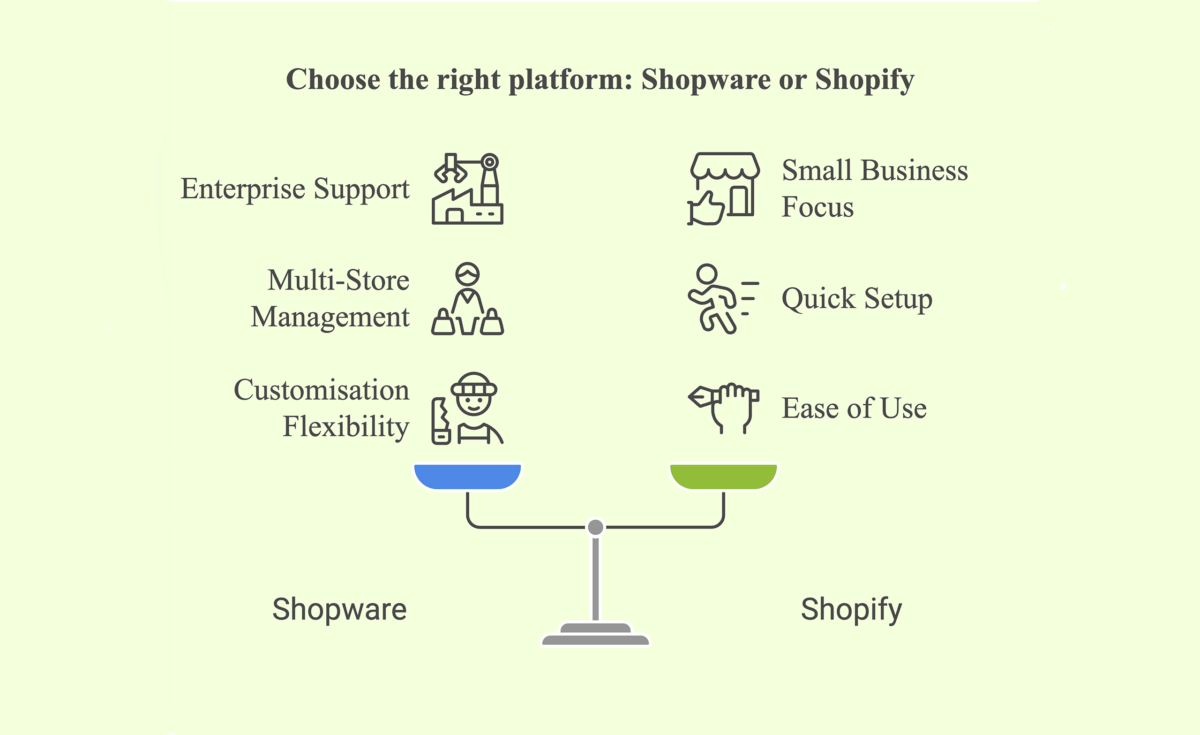
Choosing between Shopware and Shopify depends less on features alone and more on your business model, technical requirements, and long-term growth plans.
Both platforms are strong, but they are designed for different types of businesses and levels of complexity.
When Shopify is the Better Choice
Shopify is a better fit if your priority is speed, simplicity, and low technical overhead.
Choose Shopify if you:
- want to launch an online store quickly
- have a small to medium-sized product catalog
- do not want to manage hosting or infrastructure
- prefer ready-made features and apps
- run a direct-to-consumer (D2C) business
- need minimal technical involvement
Shopify works best for businesses that want to focus more on sales and marketing rather than platform management.
When Shopware is the Better Choice
Shopware is a better fit if your business requires flexibility, customization, and long-term scalability.
Choose Shopware if you:
- have complex business processes or workflows
- need advanced B2B features
- require ERP or PIM integrations
- manage large or multi-store product catalogs
- want full control over hosting and infrastructure
- need highly customized customer experiences
Shopware is especially strong for growing businesses and enterprise-level commerce setups.
Best Platform for B2B Businesses
For B2B-focused businesses, Shopware generally offers a stronger foundation due to its native support for:
- customer-specific pricing
- bulk ordering workflows
- company account structures
- approval-based purchasing systems
Shopify can support B2B use cases, but often requires Shopify Plus or additional apps to achieve similar functionality.
Best Platform for Fast-Growing Stores
If your priority is rapid scaling with minimal technical complexity, Shopify is often the easier starting point.
However, if your growth involves:
- increasing operational complexity
- multiple systems integration
- advanced customization needs
Shopware provides more long-term flexibility and control.
Conclusion
Looking to bring your unique e-commerce vision to life? Let’s explore how Shopware Agency can align with your business goals and growth plans. At 2Hatslogic, we love collaborating with businesses to understand their needs and create online stores that truly reflect their brand.
FAQ
Which platform is easier to set up if I'm new to e-commerce?
Shopify is the easier choice for beginners since it offers an intuitive setup process and a user-friendly interface. You can launch your store quickly without any technical expertise.
Will I save money using Shopware or Shopify?
Shopify has clear monthly subscription fees but charges additional transaction fees unless you use Shopify Payments. Shopware has higher upfront development costs but no ongoing transaction fees, making it more cost-effective in the long run for high-volume stores.
Can I customize my store's design and features exactly how I want?
Shopware offers complete customization of every aspect of your store since it's open-source. Shopify has more limited customization options unless you're willing to dive into custom coding.
Which platform is better for a growing business?
Shopware is better for growing businesses because it can handle complex needs like multiple storefronts and large product catalogs without requiring you to switch platforms. Shopify may require upgrading to enterprise-level solutions as your business grows.

Related Articles